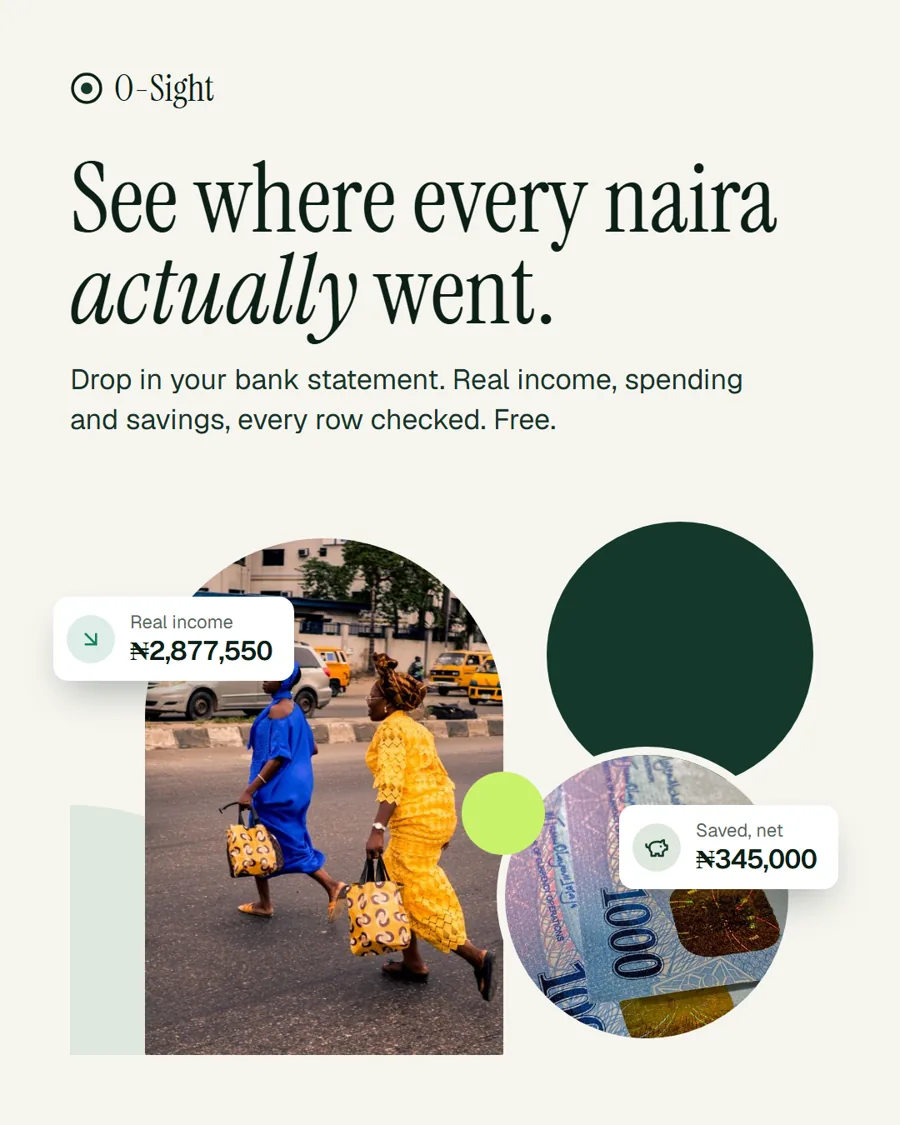
Money in is not income
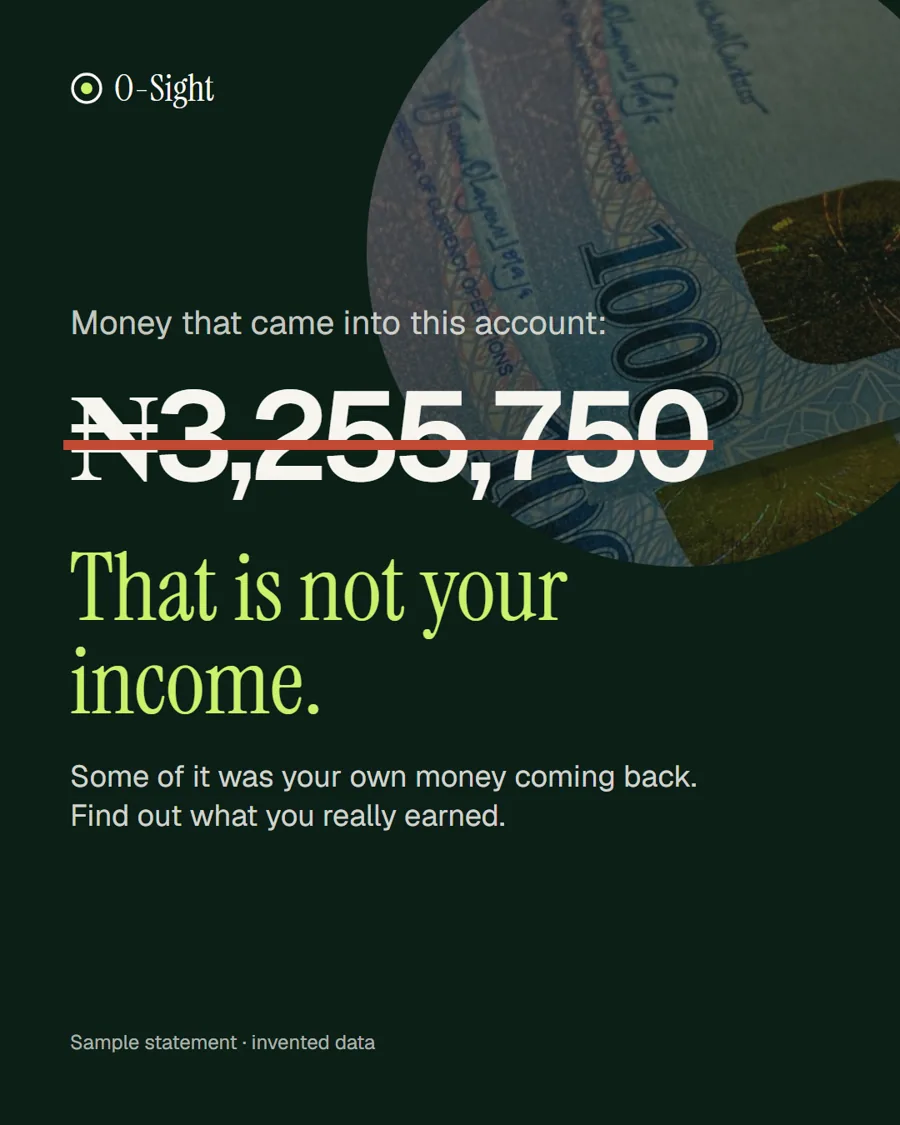
Open any bank statement and add up the credits. That number feels like what you earned, but it is not. It includes money you moved back from your own savings, refunds for failed payments, and transfers from your other accounts. On the sample statement O-Sight ships with, ₦3,255,750 came into the account, but only ₦2,877,550 of it was real income.
I built O-Sight so that anyone can drop in their statement and see three honest figures: what you really earned, what you spent, and what you kept. It began as a personal bank statement analyser, and it grew from one simple aim: financial literacy, people seeing and understanding their own money.
How it works, in four steps
1. Your statement is read on your own device
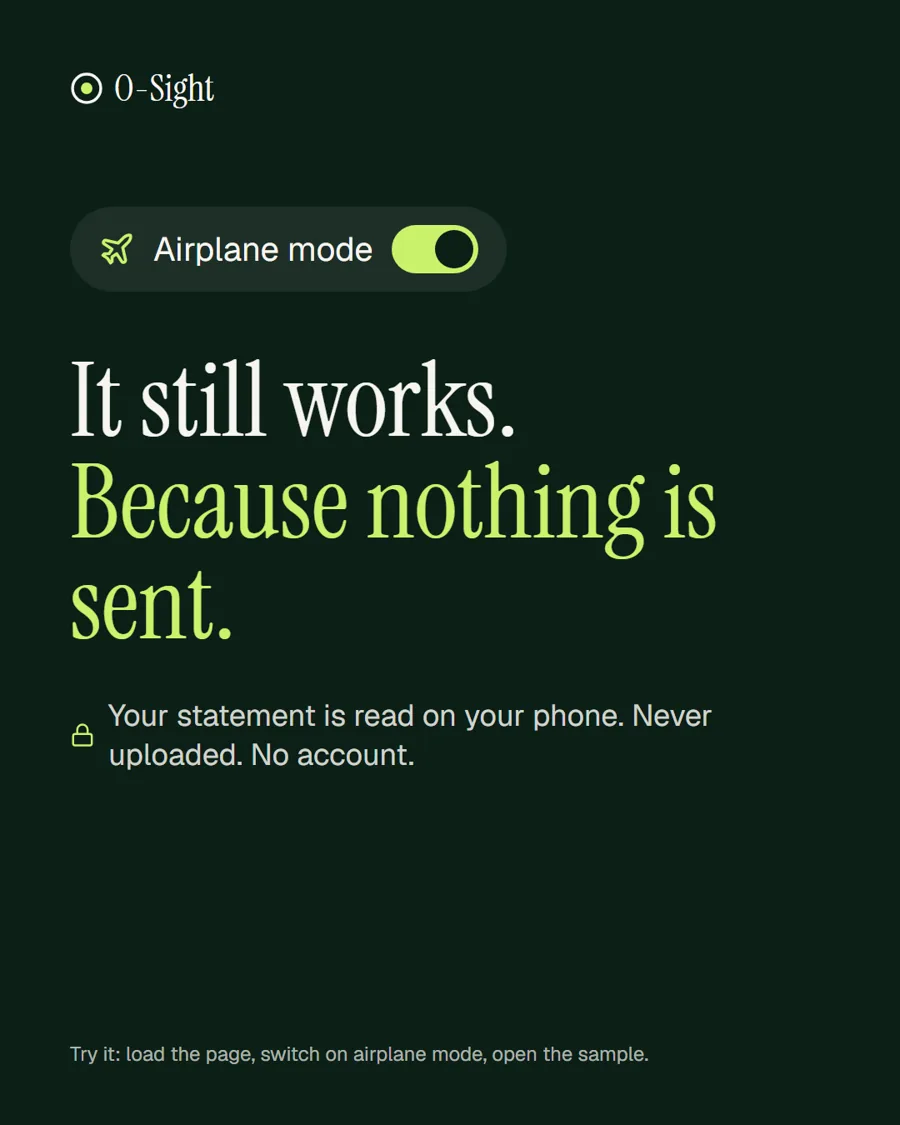
The Excel statement is opened by code running inside your browser tab. It is never uploaded, and there is no account. You can prove it: load the page, switch on airplane mode, and it still works. Close the tab and everything is gone.
2. Every row gets exactly one type
Each transaction becomes one of: income, spending, fee, savings deposit, savings withdrawal, transfer between your own accounts, reversal, or unclassified. A transfer counts as your own account when its name clearly matches the name on the statement. Anything the engine does not recognise is counted and shown as unclassified, never guessed.
3. The statement is checked against itself
This is the part I am proudest of. For every row, O-Sight checks that
previous balance − debit + credit = balance printed on the rowand that the totals match the statement's header. If rows are missing or misread, or the bank left a whole month out of the file, the dashboard says so before anything else. Real exports are messy: a bank can list a payment a few seconds before the savings withdrawal that paid for it, so O-Sight puts rows back in bank order (without adding, dropping or changing any) before checking.
4. Plain figures, plain facts
Each headline figure is defined once, with its formula shown in the app:
- Income: money from other people, plus interest.
- Spending: payments to other people, plus fees.
- Net savings: money moved into savings, minus money taken out, plus interest kept.
- Savings rate: net savings ÷ income.
There is no "financial health score" and no grade. Insights state facts with their numbers and dates, and do not judge you or tell you what to do.
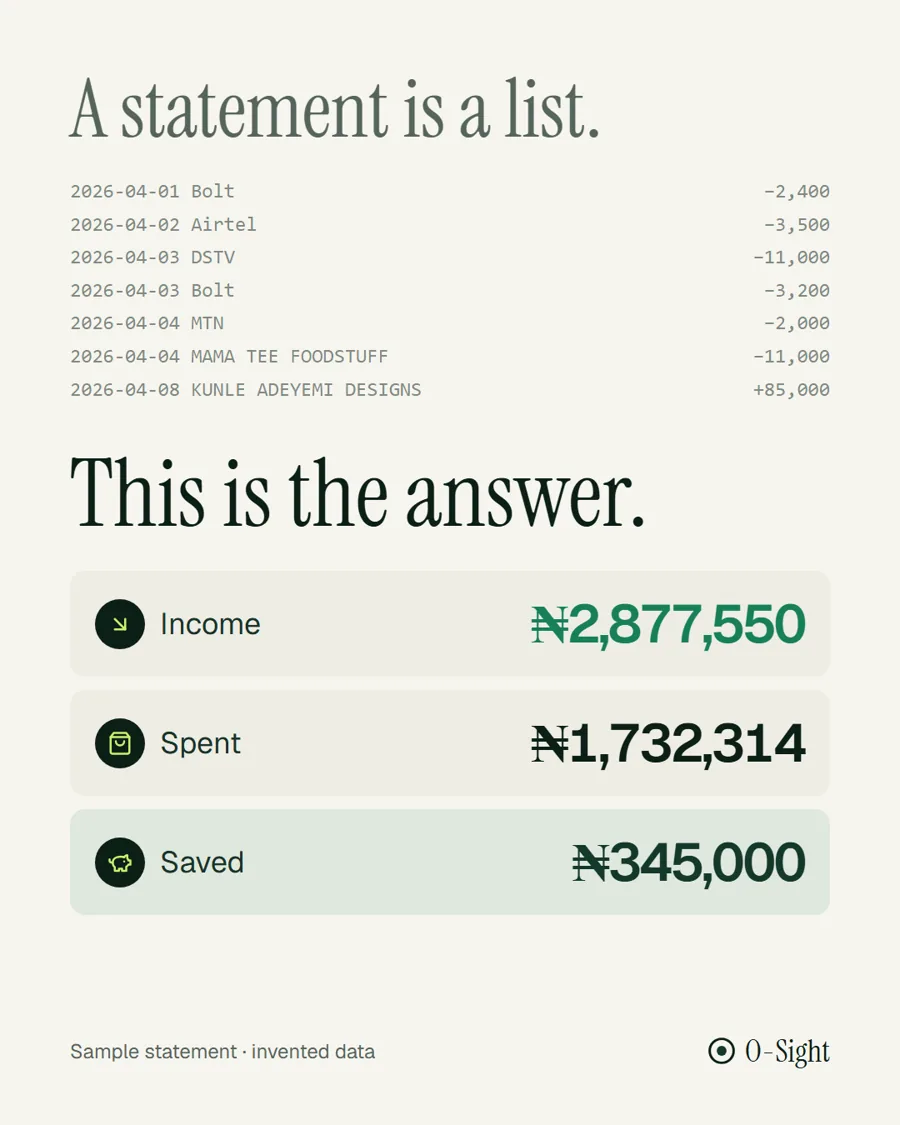
The part people share: money cards
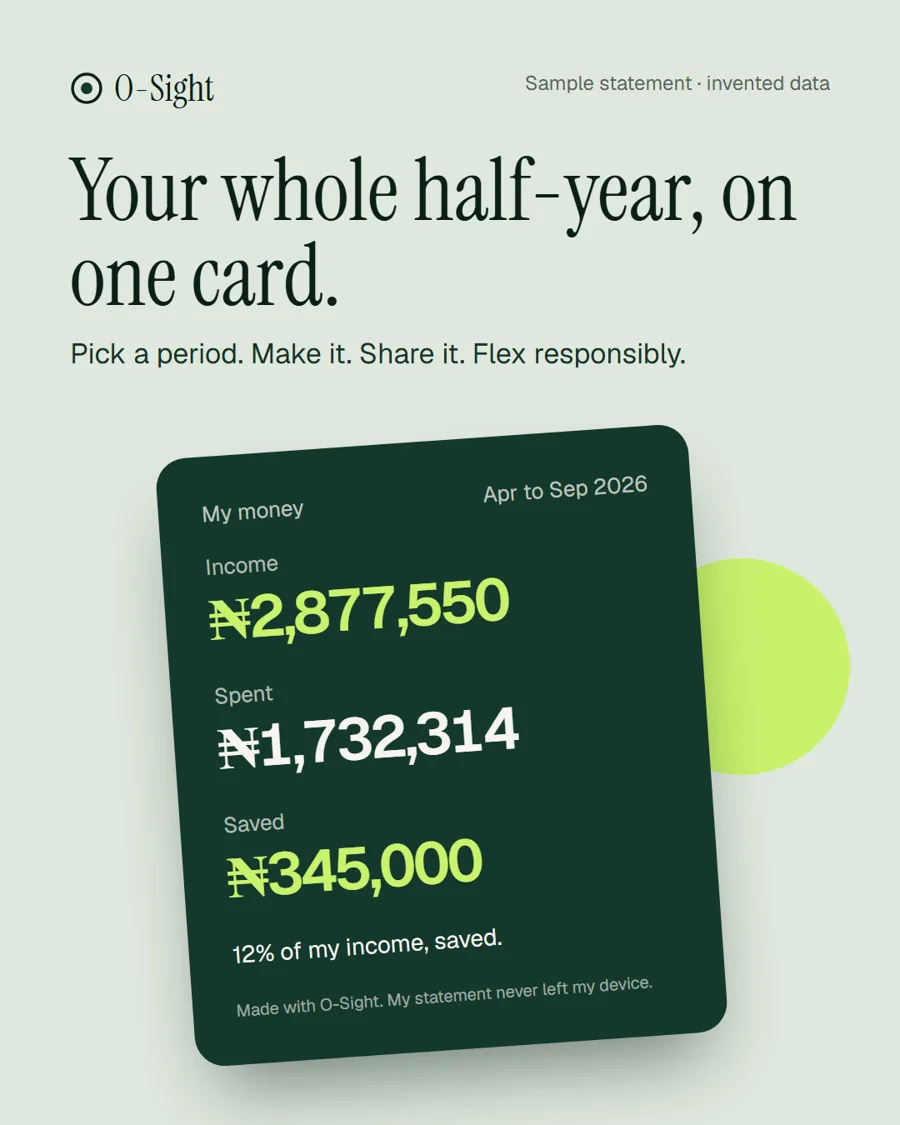
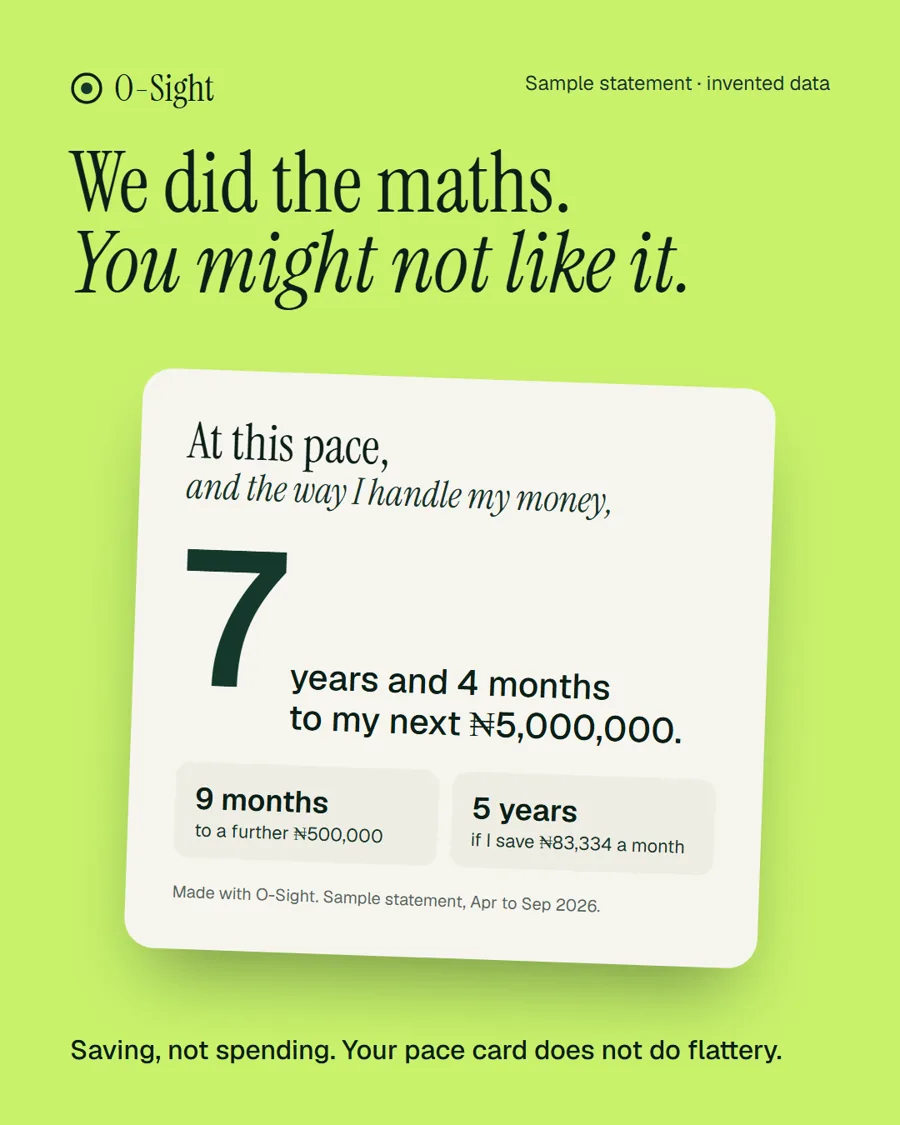
O-Sight makes pictures you can save or post, built on your phone for any period you choose. "My money" sums up a period. "My growth" sets one period against an earlier one. And "My pace" is the blunt, funny one: at your current savings pace, how long until your next ₦1,000,000? No card shows your amounts unless you switch them on, and none ever names a person.
Proof of income without a payslip
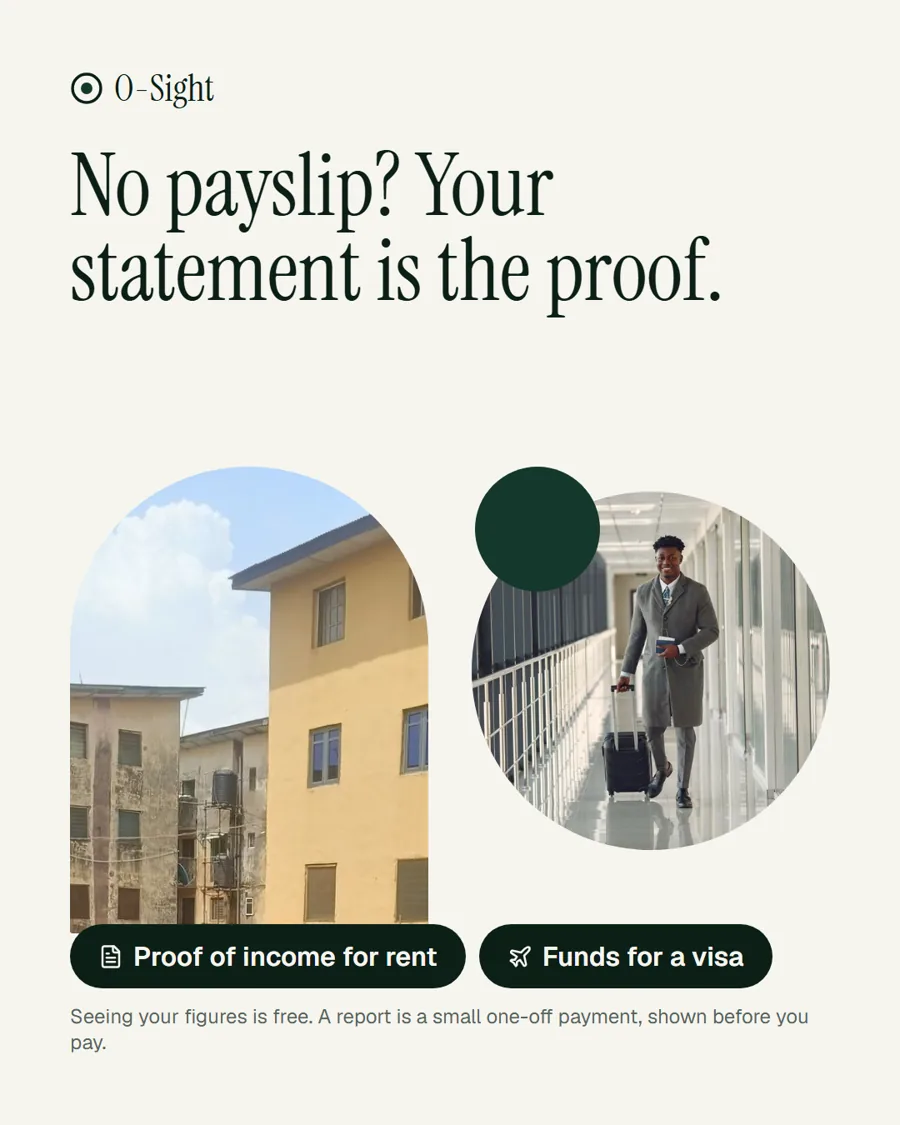
Many Nigerians earn through transfers, not payslips. When a landlord, an embassy or a lender asks for proof of income or proof of funds, the evidence is already in the statement. O-Sight can produce a one-page income report or a statement of funds for a visa, made on your device. It names missing months, lists the checks it ran, and says plainly that the figures are not verified by the bank. Seeing your own figures is free; a report is a small one-off payment.
Privacy, as rules
- The statement file is never uploaded.
- Nothing is stored in the browser. Refresh, and it is gone.
- The only thing the app can send is an anonymous contribution, and only if you press send after seeing exactly what it contains. Names and account numbers are dropped from it, not hidden.
- Contributed data is never sold, and there are no ad networks.
Where it stands
O-Sight is live and free. It reads OPay statements today, including the OWealth savings sheet, and more banks are planned as real exports become available to test with. A research paper on extracting personal financial insight from Nigerian bank statements has been submitted for review.
What it taught me
- A number you cannot check is a number you cannot trust. Reconciling every row against the balance caught parser mistakes no test would have found.
- Privacy is also a growth feature. People will only drop a bank statement into a site they can prove is not keeping it.
- Truth can be friendly. The pace card is honest about slow saving, and that honesty is exactly why people share it.
Need this kind of work done?
I take on data engineering, analytics, machine learning and research projects, and I speak and train teams on data and AI.