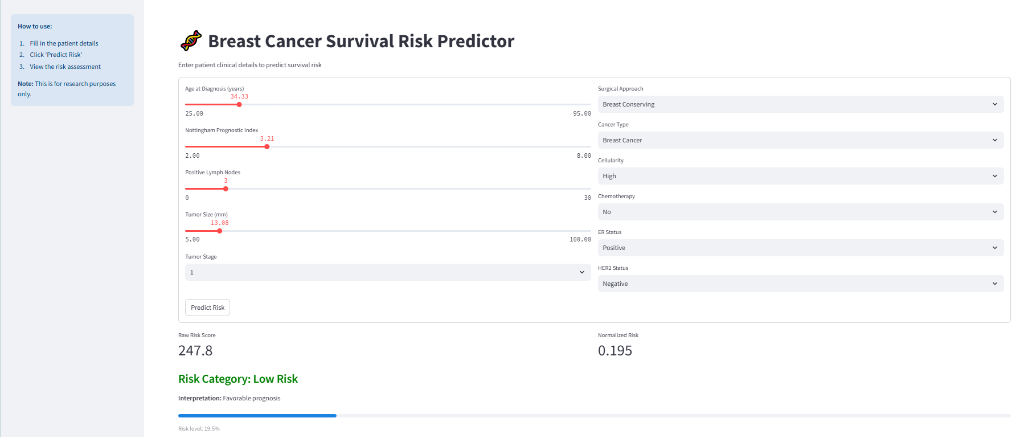
The Business Problem: An AI-powered clinical decision support system for breast cancer survival prediction, built on the METABRIC dataset using advanced machine learning techniques. It helps identify high-risk patients who may benefit from aggressive intervention.
📊 Key Results & Performance
Model Performance Comparison
| Model | C-Index | Training Time |
|---|---|---|
| Random Survival Forest | 0.7045 | 6.24s |
| Gradient Boosting Survival | 0.6913 | 3.68s |
| CoxNet (ElasticNet) | 0.6839 | 0.04s |
| CoxPH | 0.6827 | 0.80s |
Feature Importance Analysis (Top predictive features from Random Survival Forest):
- Age at Diagnosis (0.0334) - Primary risk factor
- Nottingham Prognostic Index (0.0327) - Validated clinical tool
- Lymph Nodes Examined Positive (0.0205) - Critical prognostic indicator
- Type of Breast Surgery (0.0118) - Treatment approach
- PAM50 + Claudin-low Subtype (0.0091) - Molecular classification
📉 Risk Stratification Results
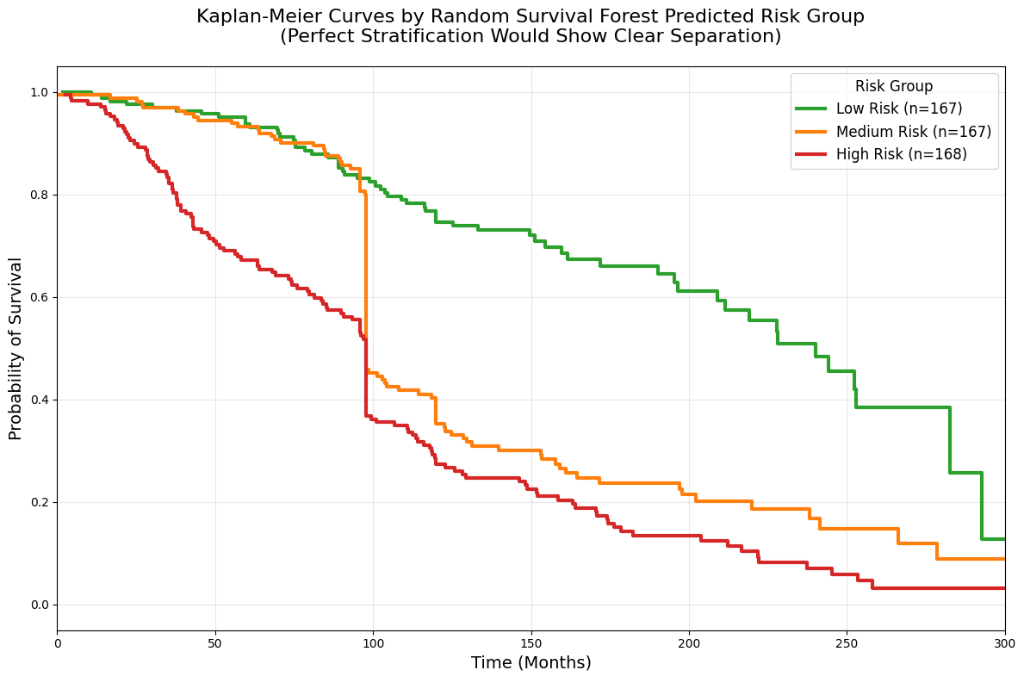
Clear separation of survival curves by risk group.
| Risk Group | Patients | Event Rate | Median Survival |
|---|---|---|---|
| Low Risk | 167 | 35.9% | 143.0 months |
| Medium Risk | 167 | 74.3% | 97.9 months |
| High Risk | 168 | 87.5% | 96.6 months |
🔬 Methodology & Clinical Validation
Data Source: METABRIC Dataset containing 2,509 breast cancer patients with 34 clinical features. Validated using Stratified train-test split (80-20).
Machine Learning Approach: Random Survival Forest evaluated using Concordance Index (C-index) with 5-fold cross-validation and Permutation importance analysis.
Clinical Validation: The model successfully recapitulates known prognostic factors:
- ✅ Nottingham Prognostic Index (validated clinical tool)
- ✅ Lymph node status (TNM staging component)
- ✅ Age at diagnosis (established risk factor)
- ✅ Tumor size (TNM staging component)
- ✅ ER/HER2 status (treatment decision drivers)
🎯 Clinical Applications
- Risk-Based Stratification: Low Risk (Consider therapy de-escalation), Medium Risk (Standard guideline-concordant care), High Risk (Aggressive multimodal therapy).
- Decision Support: Treatment planning, resource allocation prioritization, clinical trial enrollment guidance, and patient counseling.
⚠️ Disclaimer: This tool is for research and educational purposes only. It does not replace clinical judgment. Always consult with qualified healthcare professionals for medical decisions.