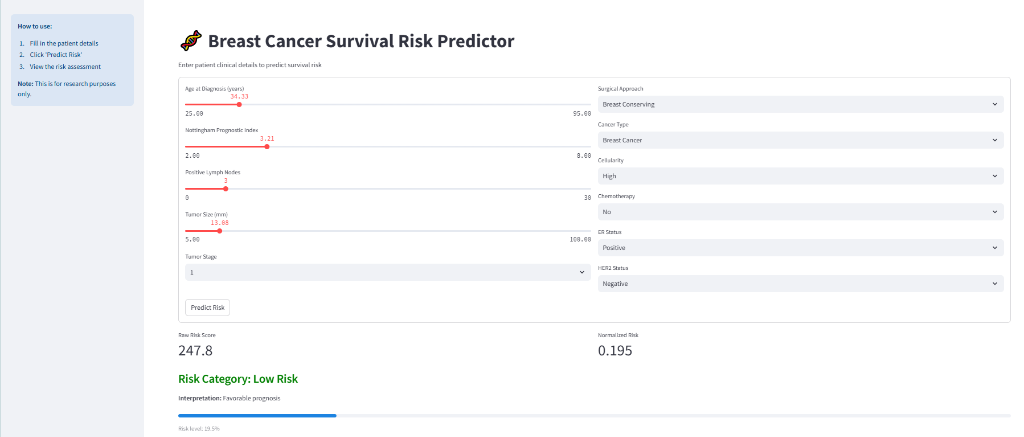
The problem: doctors need to know which breast cancer patients face the highest risk, so the most aggressive treatment and closest follow-up go where they matter. OncoVision sorts patients into low, medium and high risk from clinical data available at diagnosis.
Model comparison
Every model was scored with 5-fold cross-validation on 1,584 training patients. The winner was picked on that score alone, and the 397 test patients were used once, at the end.
| Model | C-index (5-fold CV) | C-index (test) | 10-year AUC (test) |
|---|---|---|---|
| Random Survival Forest | 0.686 ± 0.018 | 0.691 | 0.742 |
| Gradient Boosting Survival | 0.686 ± 0.014 | 0.692 | 0.749 |
| CoxNet (elastic net) | 0.680 ± 0.015 | 0.668 | 0.711 |
| Cox proportional hazards | 0.678 ± 0.014 | 0.664 | 0.707 |
The two tree ensembles are effectively tied. The Random Survival Forest was kept because it was slightly ahead in cross-validation and three times faster to train.
Risk groups on held-out patients
| Risk group | Patients | Died during follow-up | 10-year survival | Median survival |
|---|---|---|---|---|
| Low | 126 | 32.5% | 81% | 257 months |
| Medium | 139 | 56.8% | 64% | 172 months |
| High | 132 | 82.6% | 32% | 86 months |
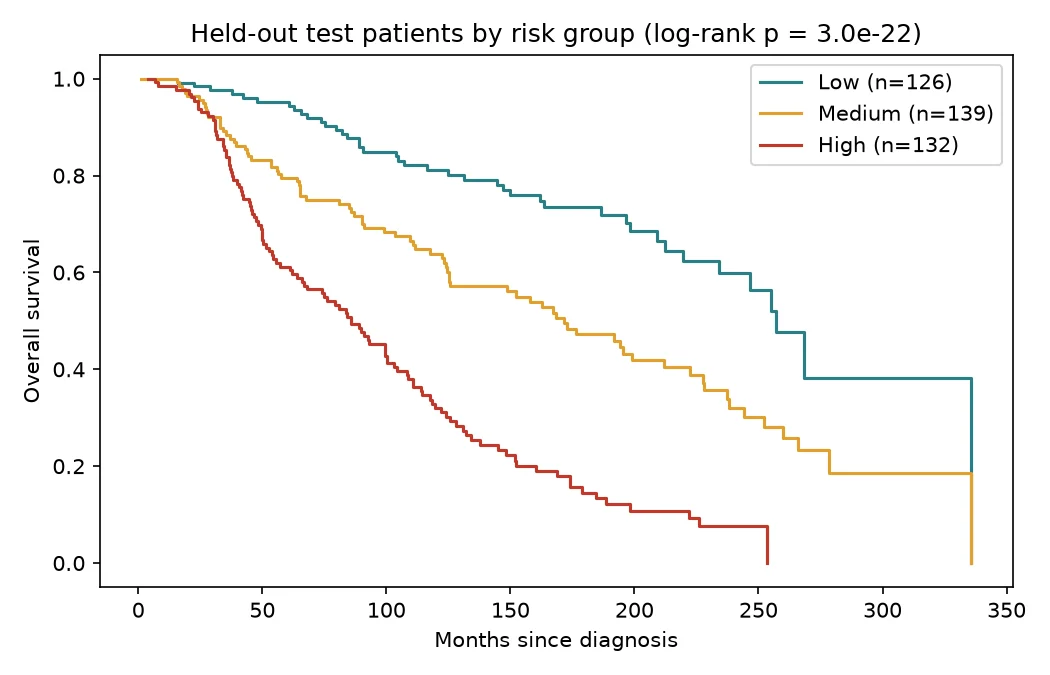
The curves separate clearly (log-rank p = 3 × 10-22).
What drives the risk
Permutation importance and SHAP agree on the top factors, and they're the ones clinicians already use:
- Age at diagnosis
- Nottingham Prognostic Index (a validated clinical score)
- Positive lymph nodes
- Tumour size
- PAM50 + Claudin-low subtype (molecular classification)
How I kept it honest
Data: METABRIC, 2,509 patients. I dropped 528 with no recorded outcome rather than guess them, which left 1,981 patients (1,144 deaths) and 21 clinical features.
No leakage: relapse status and vital status restate the outcome, so they were removed. The 1,258 missing feature values are filled inside the model pipeline, learned from training patients only.
Split: stratified 80/20 by outcome, with fixed hyperparameters, so nothing was tuned on the test set.
Research prototype. Not a medical device and not for treatment decisions. Risk groups describe groups of patients, not individuals.