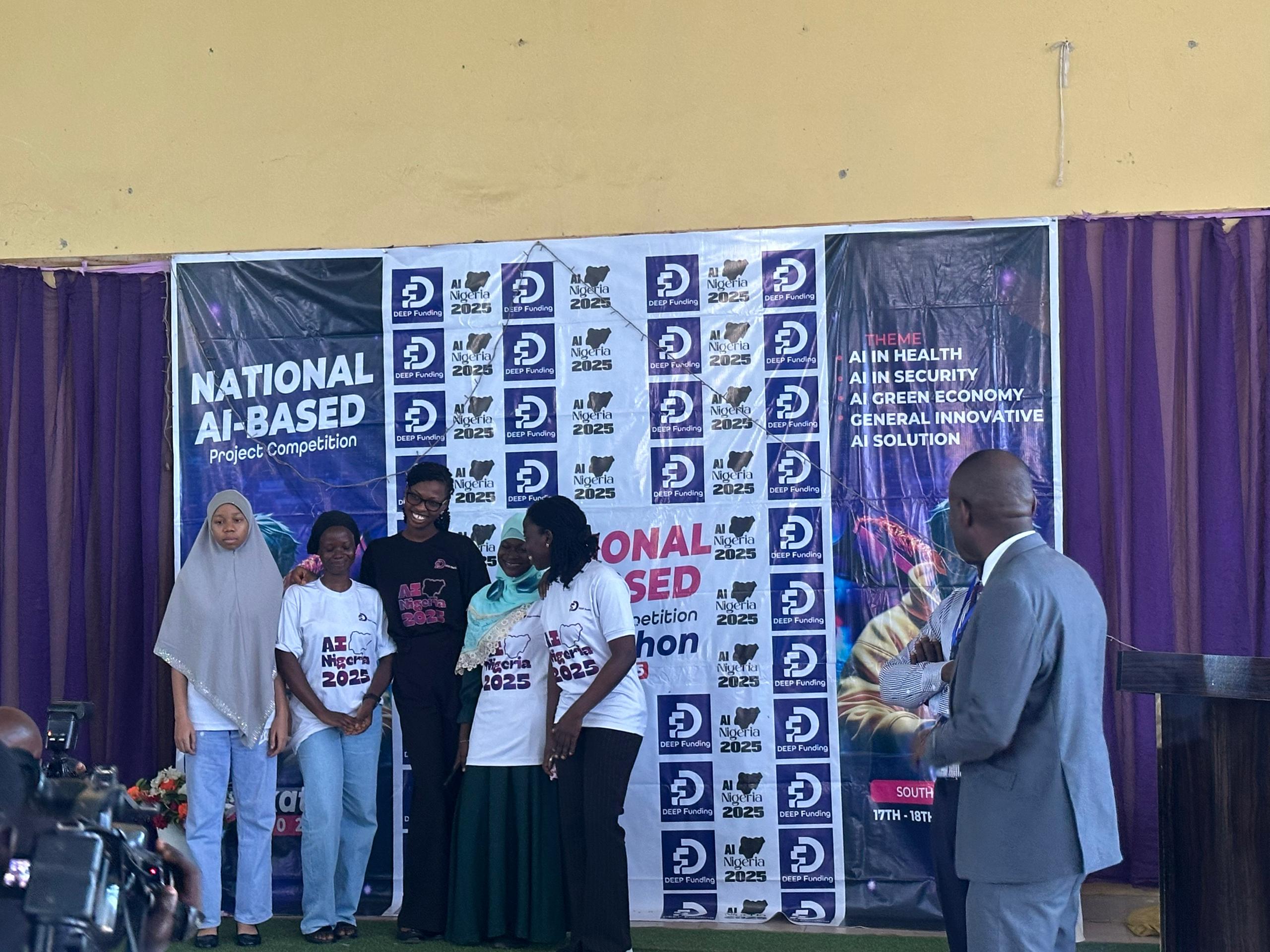
The AI project that made us amongst the Top 1% in the Southwest DeepFunding AI Hackathon in Nigeria.
I just got back from the 2-day hackathon in Ilesha—my first time there—and honestly, the trip was worth every stretch of that journey. Here’s a bit more about what went down and the project my team and I pitched at DeepFunding.io.
We built NAI-SWAMS, an AI-powered solid waste management system designed specifically for Nigeria.
✨ Hackathon Highlights:
- The Competition: I was shocked to learn that over 150 people registered, and only about 17 teams were selected. We met amazing people from Lagos, OAU, Akure, and all around the Southwest. No cap, the projects were maddddd. People came prepared. 🥹
- The Pivot: The funniest part? We had been planning this project for almost a month, only for my teammates and I to hop on a midnight call one random day (it felt like a witchcraft meeting 😂), and boom—the entire plan took a new direction. We ended up building everything in about a week, just a few days to the event!
- The Technical Session: This was actually the best part. At first, I thought they would probe us too much and scatter our confidence 😅 but it turned out to be the part I enjoyed the most. Talking deeply about the architecture, the logic, the algorithms… it pushed us in a good way.
- The Results: We scored an average of 62 points, with the first runner-up at 65. I honestly didn’t think we would score that high. I kept belittling what we had built because I felt there was still so much more we could do. And there is, but seeing the results reminded me that progress is progress.
💡 Why we built NAI-SWAMS:
Someone once told us that building a solution like this in Nigeria would be very expensive, take a lot of time and research, and maybe only be possible in “oyibo countries.” But we couldn’t ignore the daily problems we face: inefficient waste collection, struggling operators, blocked drainages, and environmental hazards. So we asked ourselves: why not us? Why can’t Nigerian students build Nigerian solutions? Listen, if you don't know what problem to solve, look around you, pick one area of concern, and address it. It has always worked for me.
🛠️ What makes our work different:
No expensive sensors and no unnecessary complexity.
- We avoided using expensive sensors; instead, we used traffic, population, events, and rainfall data to predict waste accumulation.
- Built a route optimization engine that reduces fuel consumption and emissions.
- Built our AI models specifically for Nigeria.
- And yeah, we went with a fully working prototype.
👀 In the long run:
There's been some changes to our work due to the feedback we got from the judges, but I wanted to share what we presented because I do not want to postpone this any further. My PC spoilt after the event but we move—will I stop the work because of that? No. 😂
The plan is to deploy this with real operators in Lagos to gather and validate our data and improve our model. Then, we want to add support for Yoruba, Pidgin, and Hausa to make it accessible for all drivers.
I'd have spoken on the business model we have on ground, but if you are interested in that, you can send me a DM. 🚀 We are open to all the support we can get... Collaborations, buying us a coffee, funding, sending love. My DM is open. Thank you 🥰
Where did we get data from? What did we do exactly? Check out the PDF of the Presentation slide that is attached to this post to see the full breakdown!